
1. Fund / Account / Cost Center
2. Fund Management
3. Fund Closeout
4. Fund Closeout for Federally Sponsored Projects
5. Suspended Awards
6. Post Award Management System (PAMS)
| Please refer to PAMS FAQ. |
7. Effort Reporting
| Please refer to Effort Reporting FAQ. |
8. UCPath
| Please refer to CRU website for UCPath Ledger for key announcement on the updates on UCPath issues, Direct Retro schedule, and other helpful information. |
1. Fund / Account / Cost Center
1.1 What are the fund number ranges used for sponsored projects and the associated revenue and accounts receivable (A/R) accounts?
Please refer to the Contracts and Grants Fund Table and its Attributes below for the appropriate sponsored projects fund ranges, and the associated revenue and accounts receivable (A/R) accounts.

Notes:
1) Payments received via ACH & Wire can be deposited into general CRU Account 116033-18888
2) 111501 is used for federal funds reimbursed thru LOC, 111505 used for non-LOC Federal grants
Fund range 21000-21045, 21060-21069 are reserved for Financial Aid
1.2 What is the difference between 40xxxx, 44xxxx, 62xxxx or 78xxxx accounts?
The relationship between expense accounts and the award activity type is explained in the matrix titled Linking Expense Accounts to Sponsored Award Funds.
1.3 Who links PI cost centers to account numbers on the account table?
Linkage requests should be submitted to Business & Finance Solutions by utilizing the on-line form. Please see quick reference guide on how to complete the form. For general questions, contact the Business & Finance Solutions fund manager listing.
1.4 Who should the department contact when they receive transfer of funds (TOF) error message "account/cc must be defined in table accounts"?
The department should contact Corporate Accounting’s Daniel Nguyen. Corporate Accounting has to set up this account/cc in the table accounts before EFM can link account/cc for the department.
1.5 How do I know if an invoice submitted by EFM has been paid?
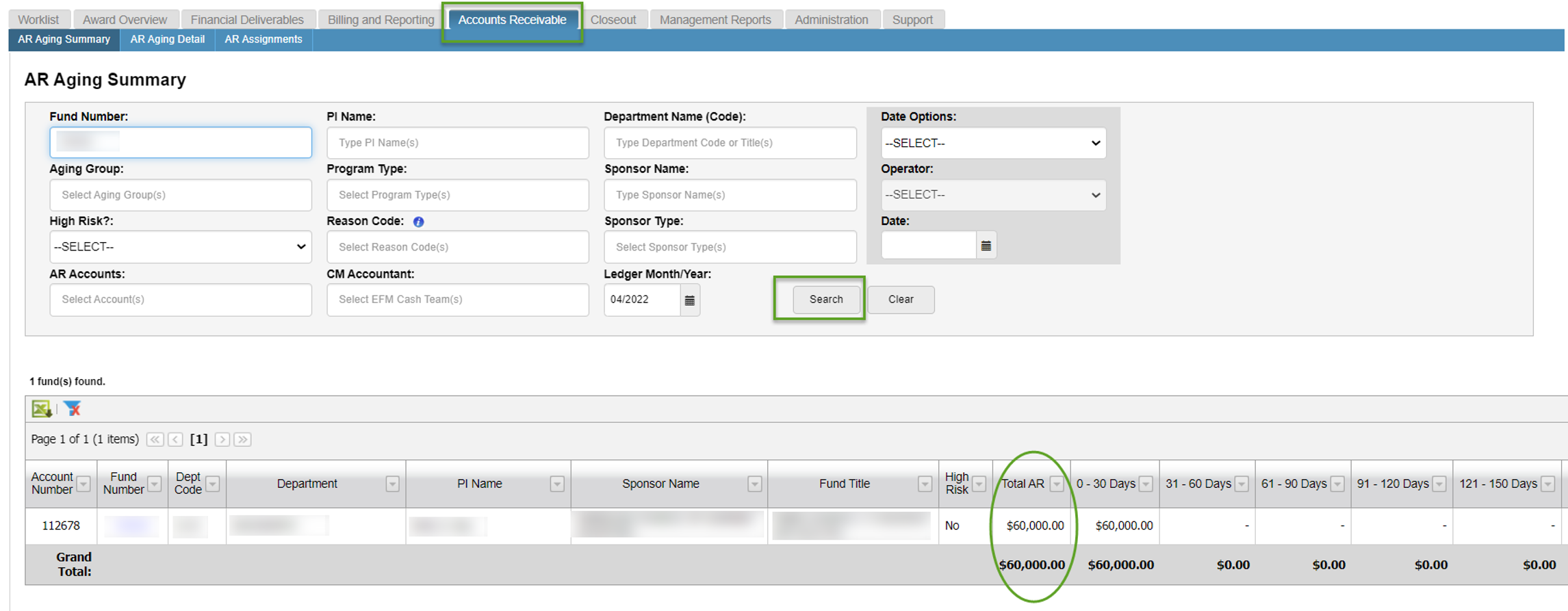
You can look up Accounts Receivable (A/R) via the Accounts Receivable tab in PAMS. The system allows searches using various parameters, including fund number, principal investigator (PI) name, sponsor, and others. Search results will display funds with outstanding A/R balances along with a summary of the aging breakdown.
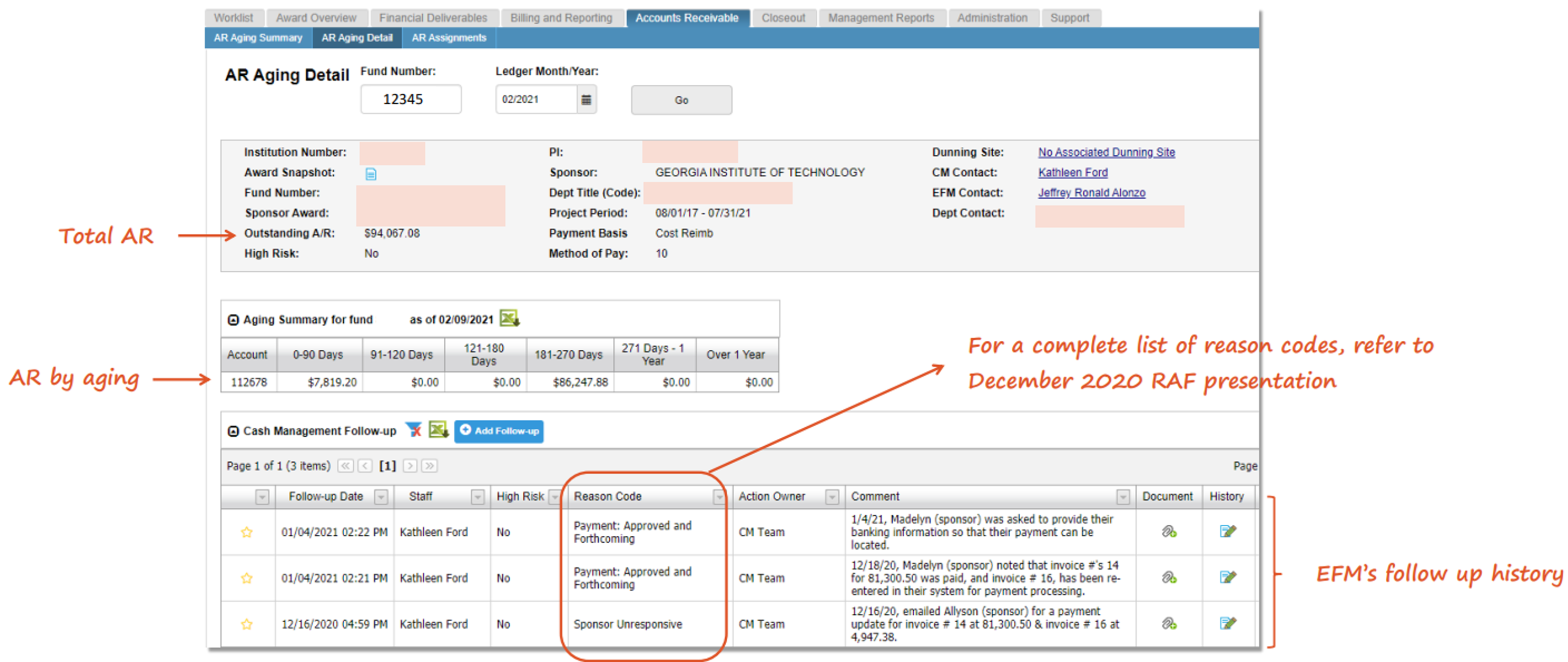
Each fund also has a dedicated PAMS A/R Details Page, where users can view award details, a breakdown of A/R aging, and a log of A/R follow up activities completed by EFM to resolve the outstanding balance.
For those who do not have access to PAMS, you may navigate to the UCLA Online Financial System to look up your fund’s A/R account listed in FAQ #1.1, by entering the account and fund number in the appropriate fields provided. To obtain access to PAMS, visit the PAMS System Access page.
2. Fund Management
2.1 Should I use the on-campus or off-campus indirect cost rate when preparing a proposal budget?
Are faculty and staff that are paid from the project located in any building on the 419-acre UCLA campus?- The off-campus rate applies to projects conducted in 100 Medical Plaza.
- The on-campus rate applies to projects conducted elsewhere on campus.
- The on-campus rate applies to projects conducted in buildings owned by the UC Regents regardless of where a building is physically located.
- The off-campus rate applies to projects when the rent is charged directly to the project.
- The on-campus rate applies to projects when the rent is paid by UCLA, but not charged directly to the project.
If a project involves work at both UC Regent-owned and third party-owned sites, the rate applied should be consistent with the location where the majority of the work is to be performed. For this purpose, salary costs are generally accepted as the measure of work performed.
The use of both rates for a given project may be justified if both rates can be clearly identified with a significant portion of the work performed as determined by salary costs. For this purpose, significant is defined as approximately 25% or more of the total project costs and a project's total salary costs exceed $250,000.
2.2 Has my award been received, processed, and appropriated?
You can check the award status on our Office of Research Portal, instructions below:
- Go to the ORA Portal
- Select the Post-Award tab
- Under "Tools," select Award Status & Synopsis Report
- Search by any of the available fields (or multiple fields)
- If the status is anything other than "Active," contact your OCGA Team.
- If the status is "Active", you can view/print the synopsis by clicking the hourglass icon under "Latest Synopsis" or you can view/print the synopsis and award documents by clicking the sheet icon under "All Docs."
Note: If you are included in the online budget transfer of funds (TOF) email list, you will receive an email notification when the award appropriation is made. You can also check on the appropriation on the Fund Summary by Fund under the Financial Systems tab of the UCLA Financial Web Reports.
2.3 How are appropriations processed for awards based on payment bases?
The procedure describing the process can be found in the Appropriations for Award Payment Bases.
2.4 What are the payment bases for sponsored research awards?
Payment bases determine how UCLA will earn and record revenue. The three payment bases are Cost Reimbursement, Firm Fixed-Price, and Firm Fixed-Rate. An award can have any combination of these payment bases: cost reimbursable, firm fixed price and firm fixed rate. The payment basis will be specified in the sponsor award document and noted on the Award Snapshot Section III: Award Demographics. The payment basis will be reflected for each award sequence, for the respective transaction budget period.
- Cost-Reimbursement: Payment is based on actual costs incurred. Revenue is earned when allowable and applicable costs are incurred up to the total approved budget. Unspent cash balances must be returned to the sponsor.
- Firm Fixed Price: Payment is based on a fixed specified amount, regardless of costs incurred. Revenue is earned in accordance with the payment schedule or as milestones are completed. Unspent cash balances can be retained by the University in accordance with UCLA Policy 913.
- Firm Fixed Rate: Payment is based on a fixed rate applied to number of units performed. An example of this type of project is a clinical trial where funding is based on the number of patients participating in the trial and payment is received incrementally. Unspent cash balances can be retained by the University in accordance with UCLA Policy 913.
2.5 If my fund has multiple payment bases and/or F&A rates, do I need to set up separate expense accounts or cost centers?
The Office of Research Administration (ORA) has a process to establish separate expense accounts or cost centers when an award has multiple payment bases and/or F&A rates at the time of award processing. If a second expense account/cost center is not provided by the department on the EPASS, ORA will contact the department. Since payment is applied differently between cost-reimbursable versus fixed rate components of an award, it is important to set-up separate expense account or cost center to segregate the appropriation and expenditures accordingly. Each expense account or cost center may only have one F&A rate so, if departments encounter specific circumstances when significant F&A adjustments are needed to assess F&A accurately (such as non-standard F&A exemptions), please ensure that separate expense accounts or cost centers are established. Departments should inform the EFM accountant of the corresponding payment basis and/or F&A rate associated for each expense account/cost center. EFM annotates this information in the PAMS Notes for the fund.
2.6 Have the funds for my award been received from the agency?
First, review the Fund Summary by Fund under the Financial Systems tab of the UCLA Financial Web Reports. The inception to date revenue indicates the total revenue invoiced/received to date. Second, to confirm that all the revenue has been received, check if there are any pending accounts receivable on the UCLA Financial Web Reports website, under the Accounts Receivable Report (search by fund range).
2.7 What is a Multi-Campus Award (MCA)?
UC Campuses may engage in sponsored projects involving one or more UC campus. A Multi-Campus Award (MCA) is an agreement that transfers a portion of a project to another UC campus or campuses. UCLA may be a recipient of an MCA or be the issuer of an MCA to another UC campus.
2.8 How do I know if my award has an outgoing MCA?
The Office of Contract and Grant Administration (OCGA) will send a notification of award to the PI, department administrator(s), EFM Team and the corresponding UC campus. The notification will include pertinent information such as budget period, amount awarded and attach the prime award terms and conditions. An EFM accountant will review the MCA and allocate budget for the MCA by rebudgeting funds from the main expenditure account to the 119800 or 119850 account.
2.9 How do I add MCA appropriations and expenses to a closeout packet?
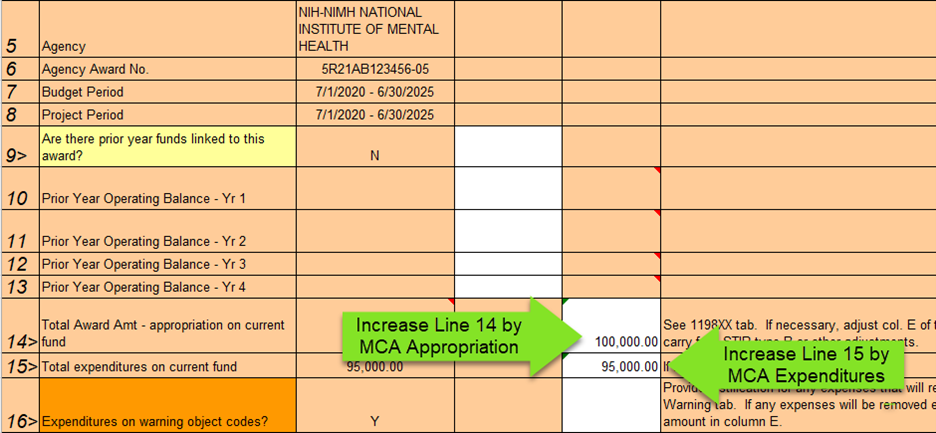
MCA appropriations and expenses are not automatically populated in the closeout packet and must be entered manually. Refer to the 1198XX tab to verify total appropriation and expenses for MCAs and add the corresponding figures in the designated sections below.
On the Closeout Checklist tab:
- Increase Total Awarded Amount by the amount appropriated to all MCAs on Closeout Checklist Line 14.
- Increase Total Expenditures by the amount expensed to all MCAs on Closeout Checklist Line 15.
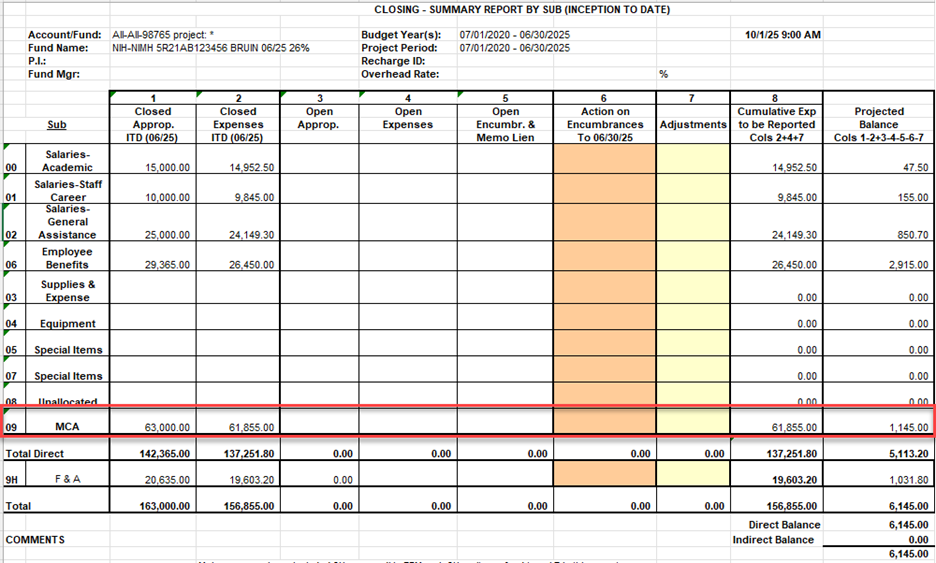
On the Summary by Sub tab (to enable editing, navigate to the Review tab in Excel and select “Unprotect Sheet”):
- Rename "Recharge" on Sub 09 line to "MCAs".
- Enter the MCA Appropriation in the "1 - Closed Approp" column and the MCA Expenditures in the "2 - Closed Expenses" column.
2.10 How is a UC intercampus subcontract paid?
First, the Office of Contract and Grant Administration must send the corresponding UC campus a notification of award (NOA). Upon receiving the NOA, the corresponding UC campus sets up a full accounting unit (FAU) and then bills EFM monthly via intercampus requests for funds. EFM then records an intercampus financial journal to the 119800 or 119850 account to transfer the requested amount to other campus(es). These payments are counted in the total project expenses.
2.11 What is a cost overrun and how is it resolved?
A cost overrun, also known as an overdraft, is when the allowable and allocable expenditures incurred to benefit the project exceed the budget approved by the sponsor. When this happens, the department provides an unrestricted FAU in the closeout packet. When EFM prepares to submit the final financial deliverable, EFM transfers expenses over the budget as a lump sum via financial journal to remove the cost overrun from the sponsored project fund. If an unrestricted FAU is not provided to EFM, EFM will use the department’s unrestricted FAU we have on file for this scenario.
2.12 What are unallowable expenditures and how are they resolved?
Unallowable expenditures are expenses charged to a sponsored project fund that are not in agreement with the sponsor’s terms. Expenditures can be unallowable for multiple reasons, including but not limited to expenditures not benefiting the project, outside of the award performance period, not included in the budget, specifically disallowed by the sponsor, unallowable object codes, animal or human expenses without IRB approval, etc. These expenditures need to be removed from the project fund by the department via one of the three options below:
- To remove unallowable payroll, the department must process Salary Cost Transfers (SCTS) in UCPath.
- To remove unallowable non-payroll expenditures, the department must remove them via the NPEAR system. The NPEAR system only allows the transferring of expenditures less than three fiscal years old. To transfer expenses older than three fiscal years, the department is to submit a financial journal request to EFM for assistance.
- To remove unallowable benefits or General and Employment Liability (GAEL), the department is to submit a Benefit Cost Transfer (BCT) Request to EFM.
2.13 Where can I find a list of non-payroll object codes and their restrictions?
You can find the non-payroll object code lookup at the UCLA Corporate Accounting website.
2.14 What is considered appropriate and sufficient documentation to submit to EFM?
For applicable expenses not posted to the general ledger or appear outside of the performance period, the following can be considered appropriate and sufficient documentation for EFM to include in a financial report or invoice.
- For non-payroll expenses,
- a copy of invoice from vendor or subcontractor is required
- For outgoing subaward/subcontract invoices
- The PI must sign or approve the invoice via email if it has not yet been approved in BruinBuy Plus
- For federal flow through subawards/subcontracts, the invoice must include the certification statement as required by 2 CFR 200.415(b): "I certify to the best of my knowledge and belief that the information provided herein is true, complete, and accurate. I am aware that the provision of false, fictitious, or fraudulent information, or the omission of any material fact, may subject me to criminal, civil, or administrative consequences including, but not limited to violations of U.S. Code Title 18, Sections 2, 1001, 1343 and Title 31, Sections 3729-3730 and 3801-3812."
- For payroll expenses,
- a listing of payroll and associated payroll-related expenses such as benefits, TIF, GAEL (as applicable) to be transferred to the fund and,
- a copy of the approved Direct Retro/Salary Cost Transfer, including any high-risk transfers approved by EFM
2.15 What documentation should be submitted to EFM for cost sharing contribution?
For mandatory cost sharing and voluntary committed cost sharing, cost shared expenses must be tracked and reported to the sponsor. The UCLA cost sharing contribution report and appropriate supporting documentation are required to be submitted to EFM for reporting. For instructions on how to complete the cost sharing contribution report, refer to the Cost Sharing Tab in the RAPID Closeout Tool User Guide.
2.16 Can I get a copy of the final invoice or financial report submitted to the sponsor?
Department user’s can obtain a copy of the final invoice or financial report directly from the PAMS Deliverables page.
For a detailed tutorial, view the PAMS training video on Deliverables.
2.17 Why is the overhead on my fund not being charged correctly?
According to the UCLA Financial Policy, departments are responsible for reviewing ledgers on a monthly basis. If there is a discrepancy in the overhead being charged, please prepare an overhead reconciliation spreadsheet detailing the correct overhead charge. Email the spreadsheet to EFM Accounting Teams.
2.18 What is STIP and how does it affect my fund?
Short Term Investment Pool (STIP) is a cash investment pool established by the UC Board of Regents to provide a high-quality, liquid investment option for short-term liquidity needs. STIP aims to:
- Preserve capital
- Earn investment income consistent with low-risk, interest-bearing assets
In simple terms, STIP is interest earned when revenue earned exceeds expenditures on a fund. More information is available at the UCLA Business & Finance Solutions website.
STIP activity is tracked in the 1198XX account of the fund. Here's how it works:
- As revenue is earned, STIP is calculated based on the UCOP published interest rate
- If expenditures are lower than the earned revenue, STIP is earned
- Use the 1198XX (Intercampus/Carryforward/STIP) report in the RAPID Closeout Tool to review STIP activity
- The 1198XX account may include other transaction types — be sure to filter the report for STIP-related entries
There are two types of STIP distinguished by how it is applied to the project fund:
- STIP A: Full STIP earnings are refunded to the sponsor. STIP is not used to cover expenses.
- STIP B: STIP is used to cover fund expenditures exceeding the awarded amount. Any remaining STIP is handled according to the sponsor's terms.
2.19 What happens when a fund is subject to E-Verify?
The department is required to use the E-Verify internet-based system to confirm that employees are authorized to work in the U.S. before charging their salaries to the fund.
2.20 When was SFN implemented? Where can I find the announcement letter?
SFN was effective February 1, 2012. The announcement from ORA AVC Marcia Smith is available.
2.21 Can I request multiple fund numbers for each budget year of a multi-year award?
Requests for exceptions to the SFN process can be submitted to the EFM Operations team using this Single Fund Number Exception Request form. Each request will be reviewed by the ORA SFN committee and exceptions will be granted on a very limited basis.
2.22 Which awards are automatically exempt from Single Fund Number (SFN), without the department making an SFN exception request to ORA?
Exception to the Single Fund Number process is granted without the department’s request for NIH T32 grants. All other training type awards are not exempt from SFN. If an award requires an unobligated balance to be reported to the sponsor like NIH T32 or has a unique circumstance that would require Multiple Fund Numbers under One Award (MFNOA), submit an SFN exception request form to the EFM Operations team.
2.23 Do I need to submit a closeout packet at the end of each budget year on the single fund number (SFN)?
No. A closeout packet (COP) is required when closing the fund in UCLA Financial System. For SFN, the fund is set up for the entire project period and closed after the end of the project period. Therefore, a COP is not required at the end of each budget period. If an award has multiple fund numbers, a COP is required at the end of each budget period to close the fund set up for each budget period.
2.24 Do I need to submit a closeout packet for the final invoice or final report at the end of each budget year on SFN?
A Closeout Packet is not required for the final invoice or final report at the end of each budget year on SFN until the fund is closed at the end of the project period. EFM will provide the department with an expense analysis using the EFM email template. Departments are expected to submit a response to EFM within the time period indicated in the EFM email.
2.25 Is there more SFN FAQ available?
For more SFN FAQs, please visit: FAQs for Single Fund Number (SFN).
2.26 What is a Final for Budget Period financial deliverable?
It is the final invoice or financial report to close a budget period of the award. A final for budget period financial deliverable is completed when the award terms and conditions state that the sponsor’s approval is required to carry over unobligated balances from one budget period to the next.
2.27 How do I manage Supplement funding received under the main award?
If the award terms and conditions state that Supplement funds are restricted, to be used only for the intended purpose as stated in the award agreement, the department must establish a separate expense account/cost center on the fund. The home department should process a transfer of funds (TOF) and notify the EFM accountant with a request to link the account/cost center to the fund by e-mail. Once the account/cost center is linked to the fund, the department is able to charge expenses to the supplemental funding FAU. Supplement funds must be tracked separately from parent funds, and unspent balances noted in the financial report submitted to the sponsor.
2.28 What is account 400005 on my fund?
This account is used to segregate restricted carry forward balances.
When the financial deliverable is due for an award with restricted carry forward, the EFM accountant prepares it, working with the department as needed to finalize expenses for the budget period. If there is an unspent budget (unobligated balance) at the end of the budget period, the EFM accountant indicates the Principal Investigator (PI)’s intent to request the carry forward balance in the invoice or financial report. The inclusion of this statement is not considered a carryforward request, and the PI must submit a formal carryforward request to the sponsoring agency through OCGA. If there is an unspent budget remaining from the budget year, EFM accountant links the holding account 400005 to the fund and moves the budgetary balance from the department expense account (and linked department expense accounts, if any) to the holding account. The balance in the holding account is restricted from spending until the sponsor’s approval is obtained.
EFM will request payment up to the total amount authorized for spending, excluding restricted funding, until the carry forward is approved.
If the sponsor approves to carry forward the balance, EFM accountant moves the balance from the holding account 400005 to the home department expense account, making it available for spending.
If the sponsor does not approve to carry forward the balance, the EFM accountant de-obligates the balance in the holding account. The total appropriation on the award is reduced by the balance.
2.29 What is account 400006 on my fund?
This account is used to segregate funding restricted for spending for reasons other than restricted carry forward.
When the award includes funding restricted for spending until certain conditions are satisfied, upon receipt of the email notification from ORDM, EFM accountant will place the restricted amount in the holding account 400006.
In the PAMS Financial Deliverables page, the field titled "Spending on Hold" will indicate the fact that there is a balance restricted from spending until the award conditions are satisfied.
When the award conditions are satisfied, the department fund manager assists the PI in requesting for the sponsor to lift restrictions through OCGA. Once the sponsor lifts the restriction, ORDM will email the EFM accountant and copy the EFM Assistant Director. The EFM accountant will release the funds from the restricted funding account back to the home department expense account. The "Spending on Hold" flag will be updated to "No".
EFM will request payment up to the total amount authorized for spending, excluding restricted funding, until the restriction is lifted.
When the financial deliverable is due, EFM prepares it, indicating the restricted budget and its balance when required, working with the department as needed, to submit it to the sponsor.
2.30 What do I need to review prior to submitting the Termination notice to the Business Official in xTrain?
Verify that the total stipend payments on the Termination Notice reflect stipend payments in the UCLA general ledger.
2.31 Who needs to certify the termination notice prior to routing for Business Official review?
The fellow is advised to review the termination notice with his/her departmental fund manager or fellowship coordinator before routing to the BO. Termination notices are to be electronically certified by the trainee and the Principal Investigator.
2.32 Who is the Business official to review the Termination Notice?
The Business Official selected should be the EFM fund manager for the sponsoring (mentor's) department.
2.33 I submitted the Termination Notice to the wrong Business Official. How do I route this to the correct Business Official?
In xTrain, recall the termination notice and select the appropriate EFM fund manager for the sponsoring (mentor's) department.
2.34 What do I do after the Termination notice is submitted to the Business Official?
If the termination notice’s figures agree with the UCLA ledger figures, EFM approves the termination notice through xTrain and submits to NIH for review. If the Termination Notice figures do not match with the UCLA ledger figures, EFM routes the Termination notice to the fellow. The sponsoring department is to correct the payments in the UCLA ledger and/or a revise the NRSA Termination Notice in xTrain.
Additional Reference:
2.35 How can I identify and remove benefits included in the CBR but not allowed on NIH NRSA grants?
Per the NIH Grant Policy Statement Section 11 Ruth L. Kirschstein National Research Service Awards, costs normally associated with employee benefits (such as FICA, workman’s compensation, life insurance, union dues, and unemployment insurance) are unallowable.
The unallowable benefit percentage included in the CBR is as follows:
| Fiscal Year | Employee Group 4: Other Academics |
Employee Group 5: Post Docs |
Employee Group 8: Employees & Students with Limited Benefits |
|---|---|---|---|
| 18-19 | 15.12% of CBR | ||
| 19-20 | 14.68% of CBR | ||
| 20-21 | 12.57% of CBR | ||
| 21-22 | 12.50% of CBR | 70.50% of CBR | |
| 22-23 | 21.70% of CBR | 13.40% of CBR | 72.00% of CBR |
| 23-24 | 20.8% of CBR | 12% of CBR | 64.7% of CBR |
| 24-25 | 21.20% of CBR | 11.50% of CBR | 65.20% of CBR |
| 25-26 | 20.90% of CBR | 10.90% of CBR | 62.60% of CBR |
Please transfer off the unallowable benefits from grants following the Benefit Cost Transfer process as shared at July 2022 RAF.
2.36 When does UCLA report program income for National Science Foundation (NSF) awards?
NSF requires all awardee organizations to report the amount of program income earned and expended as of September 30th each year. Awardee organizations are required to submit a program income reporting sheet by November 14th. The program income reporting sheet must include all NSF awards granted to the organization and is subject to program income according to the award’s terms and conditions. If an award is not subject to program income, it does not need to be included in the report sheet.
2.37 What is Payment Management Services (PMS)?
The Payment Management Services (PMS) is a shared service provider used by US Federal Agencies to manage the disbursement of grants funds. PMS facilitates the drawdown, reporting and monitoring of federal funds awarded to recipients. You can read more about PMS here: https://pms.psc.gov/
2.38 What is a document number on a federal award?
The document number is a unique identifier in the Payment Management Services for a specific award. The document number can be found in the notice of award and used to complete cash drawdowns on the letter of credit, report disbursements and track payments. There can be more than one document number to one award.
2.39 If there is more than one PMS document number under one award, will there be a separate fund number?
Yes, a new fund number will be assigned for each document number. In the financial system, one fund number is associated to one PMS document number. Each PMS document number requires a separate Federal Financial Report, so a distinct fund number is created for tracking. Assigning a new fund number allows for separate tracking of budgets, expenses, and revenue for each document number.
3. Fund Closeout
3.1 How can I receive the automatic notifications for fund expiration?
- Automated Notifications go out to the following contacts.
- The email address of the fund’s Department Contact in PAMS.
- The email address of the fund’s Principal Investigator (CC recipient).
- The listserv email address stored in the Proposal Award Tracking System (PATS). PATS only stores one contact at a time.
- The recommendation for the listserv contact is: A Distribution List or a Shared Mailbox. Not an individual name.
- Distribution List (DL): forwards incoming messages to each member linked to the DL. It’s set up and managed by the department’s local IT office.
- Shared Mailbox: Is an actual mailbox with space to retain all incoming/outgoing messages. It is set up and managed by the department’s local IT office.
- The Office of Research Information System (ORIS) may be contacted at support@research.ucla.edu only when current contact address is unknown and/or an update of the proper distribution address (if outdated) is needed. In your request to ORIS please include the department code and the distribution email address.
3.2 When is a due date to submit a closeout packet to EFM?
Closeout packet due dates are available in PAMS. For those interested in the logic of how due dates are calculated, refer to the table on the Closeout Packet Deadlines page.
3.3 Should a closeout packet be submitted if a no-cost extension or continuation request is pending for the award?
No. Please submit to EFM correspondence with the awarding office (OCGA, TDG, or CTC&SR) or the sponsor indicating that a No Cost Extension (NCE) or continuation is in process. EFM will create a deliverable in PAMS for an interim financial deliverable and update the original final financial deliverable status to "Pending Department Action – Continuation/No Cost Extension Pending." EFM will not close the fund.
3.4 In my PAMS worklist, I see a closeout packet is due to EFM 7 days before the final deliverable is due to the sponsor. Is the closeout packet due date correct?
The closeout packet (COP) due date to EFM is calculated by comparing the project period end date of the award and the final deliverable due date in PAMS. This scenario can occur when the current awarded budget period has ended, but the project period end date is in the future. In those cases, the final financial deliverable is set up through the fully executed budget period and PAMS will default the closeout packet to be due to EFM 7 days from the budget period end date.
The award may be anticipating continuation funding for the next budget period which has not been received or processed. When the department confirms the pending continuation to their EFM Accountant, EFM will prepare a financial deliverable covering through the current budget period end date.
If the fund is ending, at the time of preparing the final financial deliverable, the EFM Accountant will reach out to the department fund manager to proceed with completing the final financial deliverable by the sponsor’s deadline.
When the award is executed for the entire project period, the closeout packet is due 30 days prior to the final deliverable due date*.
Example:
| Project Period End Date |
Budget Period End Date |
Final Financial Deliverable Due Date |
"COP Due to EFM" Date (In PAMS) | Correct "COP Due to EFM" Date |
|---|---|---|---|---|
| 12/31/2023 | 12/31/2022 | 3/31/2023 (Final Financial Deliverable is due 90 days after Budget Period End Date) |
3/24/2023 (PAMS defaults to 7 days prior to the Final Financial Deliverable Due Date since the Project Period End Date is in the future) |
3/01/2023 (Fund has a 90 day closing period. COP is due to EFM 60 days after the Budget Period End Date) |
| 3/31/2024 | 3/31/2023 | 5/30/2023 (Final Financial Deliverable is due 60 days after Budget Period End Date) |
5/23/2023 (PAMS defaults to 7 days prior to the Final Financial Deliverable Due Date since the Project Period End Date is in the future) |
4/30/2023 (Fund has a 60 day closing period. COP is due to EFM 30 days after the Budget Period End Date) |
*See FAQ 3.2 and 3.3 for due date calculations
3.5 I need to prepare a closeout packet. Where can I find the RAPID Closeout Tool?
The RAPID Closeout Tool is used to generate the closeout packet for sponsored project funds. You can download the latest version of the RAPID Closeout Tool from the ORA Portal: https://portal.research.ucla.edu/PostAward
3.6 Can EFM give department access to withdraw an early submitted closeout packet in order to make an update?
PAMS does not have a designated 'Withdraw' button available for departmental use. If it becomes necessary to withdraw a closeout packet that was submitted prior to the due date in PAMS, reach out to your EFM contact and request that the closeout packet be rejected back to the department.
3.7 I missed the deadline to submit a closeout packet to EFM. Are costs at risk for non-reimbursement?
Even if EFM has not received a closeout packet, to ensure recovery of allowable and applicable costs incurred for the project, EFM will prepare the final invoice or financial report based on expenses per the general ledger, and submit it to the sponsor on time. In absence of closeout packet, EFM will exclude costs that are deemed questionable from the final invoice or financial report.
3.8 I missed the deadline to submit a closeout packet to EFM. When EFM prepares the final invoice or financial report without a closeout packet, will I be informed of the final expenses invoiced or reported to the sponsor?
- For federal awards, EFM will inform the department of the final expenses after submission of the final to the sponsor based on EFM’s analysis (see Financial Closeout of Federally Sponsored Projects).
- For non-federal awards, EFM will inform the department of the final expenses based on EFM’s analysis before the submission of the final to the sponsor and the department is required to respond within the indicated due date. (see Financial Closeout of Sponsored Projects Procedure).
3.9 I missed the deadline to submit a closeout packet to EFM for a non-federal award. EFM has notified me of the total expenses to be included in the final invoice or financial report. I have additional expenses that need to be included. Can these be included in the final invoice or financial report?
If a list of all adjustments and supporting documentation is submitted to EFM by the deadline indicated in the EFM’s final analysis email, EFM will verify these transactions are allowable and allocable to the project and include, if deemed appropriate. If a complete list and supporting documentation is not provided by the deadline, EFM cannot verify if transactions are allowable and applicable. Therefore, EFM will not include these transactions in the final invoice or financial report.
3.10 I missed the deadline to submit a closeout packet to EFM. How will EFM prepare a final financial report in absence of a closeout packet, when restricted funding has been awarded and must be disclosed in the final financial report?
If a closeout packet is not submitted to EFM by the deadline, the balance of restricted funds will not be disclosed in the final invoice for financial report, thereby placing restricted funds at risk for non-reimbursement by the sponsor.
3.11 Who processes Policy 913 Transfers and acct/cc link to fund #69970?
Campus departments are responsible for requesting Policy 913 fund transfers to EFM. Upon receipt of the request and Closeout Packet, EFM will confirm adequate responses to the P913 questions and the unexpended balance amount. Once confirmed, EFM will transfer the unexpended balance amount to the department’s designated account/cost center and fund 69970. Account/cost center/fund linkage is processed by Corporate Accounting upon submission of Transfer of Fund by EFM. Campus departments are not required to make a separate linkage request to either EFM or Corporate Accounting.
3.12 For industry sponsored clinical trials, who submits the invoice to the sponsor?
Throughout the life of the award, the frequency of invoicing the sponsor can vary based on subject related activities. Because of this, department administrators issue the invoice to the sponsor. When payment is received, EFM applies payment to the award.
3.13 For non-industry sponsored clinical trials, who submits the invoice to the sponsor?
EFM issues invoices for all awards, except industry sponsored clinical trials. EFM works with the department administrators as needed to submit the invoices to the sponsor.
3.14 I’m closing an award subject to UCLA Policy 913. What are the Policy 913 assurances?
In accordance with UCLA Policy 913, the Principal Investigator must provide the following written assurances when unexpended balances exist for the award: 1) All work under the award has been completed 2) All reports submitted to the sponsor 3) All costs of conducting the work appropriately charged to the fund established for the award 4) All invoices submitted and all anticipated payments received. These assurances are provided in the closeout packet, so a separate letter is not required. The PI’s certification in the closeout packet implies that the PI has reviewed all information contained in the closeout packet, including the Policy 913 assurances.
3.15 Do I need to obtain a separate letter for Policy 913 assurances when it is included in the PI certified COP?
No, a separate letter for assurances will not be required if included in the RAPID closeout packet. Placing a signature on the certification implies that the PI has reviewed all information contained in the COP including P913 assurance. Keep in mind for balances greater than 25% of the amount received, the PI is still required to provide additional justification for the large unexpended balance.
3.16 For awards subject to Policy 913, when is Department Chair or ORU Director’s endorsement required?
In accordance with UCLA Policy 913, endorsement from the Department Chair or ORU Director is required for all Policy 913 cases regardless of balance. Endorsements from the Department Chair or ORU Director can be provided by including their names and signatures on the closeout packet certification page. Endorsements from the Department Chair or ORU Director can also be provided via email, as long as the PI’s assurances and justification are also included in the email that is being endorsed.
3.17 Can PI certifications and endorsement from the Department Chair or ORU Director be confirmed via email?
Yes, PI’s certification and endorsement from Department Chair or ORU Director can be obtained via email as long as assurance and justification were included in the email to be transparent what they are certifying.
3.18 I have a firm fixed or price contract or non-refundable grant that is fully spent. Do I need to submit written assurances required by policy 913 to EFM even when my fund does not have an unexpended balance?
No, policy 913 describes how to dispose an unexpended balance on a firm fixed or price contract or non-refundable grant. If your fund is fully spent, policy 913 is not applicable; accordingly, written assurances will not need to be provided to EFM to close out the fund.
3.19 How can I request a revision to the final invoice and/or financial report previously submitted to the sponsor?
Once EFM submits the final to the sponsor, revisions will be processed only in exceptional circumstances. Revision request forms, which can be found on the Standard Forms and Other Resources page of the Fund Management menu, must be submitted to EFM including an explanation for the cause, management’s plan to prevent revisions in the future, and approval of the Department’s Administrative Officer (e.g., CAO, CFO, Director, or equivalent position) along with a revised closeout packet. When revision requests are made, all allowable and applicable expenses must have been posted to the general ledger and unallowable or inapplicable expenses must have been transferred off the fund. For additional information, please refer to the procedure on Revising Final Financial Deliverables in EFM Policies and Procedures.
3.20 Why is it required for all expenses to be posted to the project fund before considering a Revision Request?
Revisions to the original final financial deliverable submitted to the sponsor indicate errors were discovered. EFM requires all expenses be posted to the project fund before considering a Revision Request to prevent subsequent revisions. When all pending expenses are properly recorded to the project fund, there is complete certainty of total expenditures to be reported in the revised deliverable.
3.21 An open encumbrance is preventing EFM from closing my fund. How do I close it?
A purchase order (PO) should only be closed if no additional invoices are expected to be paid against it. POs for subawards, subcontracts, or those equal to or greater than $10,000 must be closed by Campus Purchasing. Department Fund Managers can submit a support ticket to request PO closure in these cases. All other POs can be closed via the "Soft Close PO" action in BruinBuy Plus. Five days after a PO is soft closed, all associated encumbrances will be released, and the PO status will change to closed. Instructions on how to soft close a PO can be found as part of Purchasing’s BruinBuy Plus Hub, under the PO Closure training.
3.22 How do I find expired funds requiring my action to close?
Under the Management Reports section in PAMS, you can access the Expired Funds to Close Report. It contains funds that expired 120 days ago or earlier that have not been closed in the financial system.
3.23 What are reasons for expired funds to stay open in the financial system after 120 days?
The Expired Funds to Close Report groups funds into categories that identify reasons why funds cannot be closed, some requiring department and/or EFM’s action, see examples below.
- A delay in submitting the final financial deliverables. The status of the final financial deliverable is available in the Expired Funds to Close report. If the status indicates "Pending Department Action", EFM needs assistance from the department to complete it, and comments explain the information pending.
- Expenses on the fund do not agree with the Final expenses reported to the sponsor. The final financial deliverables may have excluded unallowable expenses recorded on the fund and/or included applicable expenses that have not been recorded on the fund when adequate supporting documentation is provided. In either scenario, the Department needs to reconcile expenses to the final expenses reported to the sponsor.
- Encumbrance and/or memo-lien to clear. The fund expired 120 days ago or earlier and there should not be any expenses incurred after the project period ended. Departments should clear encumbrance and memo-liens from the expired fund.
- Outstanding Account Receivable (AR). In the Accounts Receivable page in PAMS, you can find the total AR balance, the latest action EFM has taken, the reason for a delayed payment, and more information. When a delayed payment is due to a dispute on the non-financial deliverables, EFM needs department assistance in resolving the issue closely working with other central offices.
3.24 When can a fund be closed in the financial system?
A fund can be closed when the following items are complete:
- All financial deliverables have been completed/submitted to the sponsor.
- Expenses on the fund agree with total expenses in the final invoice/financial report.
- The fund operating balance is zero.
- All payments have been collected, and accounts receivables balance is zero.
4. Fund Closeout for Federally Sponsored Projects
4.1 What are the key areas that are changing with this procedure?
Below is a summary grid of key changes.
|
Area |
Change |
|---|---|
|
Closeout Packet Not Submitted |
EFM submits the final financial deliverable to the sponsor based on expenses posted to the general ledger at the time of preparation. The PI and Department Administrator are notified after submission. |
|
Closeout Packet Submitted but Inaccurate/Incomplete |
The inaccurate and/or incomplete closeout packet is flagged in PAMS and an email notification is sent to the PI and Department Administrator. EFM submits the final financial deliverable based on expenses posted to the project fund and includes properly documented expenses from the closeout packet. |
|
Payroll Expenses |
Must be posted to the project fund by the closeout packet due date to EFM. |
|
Non-payroll Expenses |
If not yet posted to the project fund, must be supported by an invoice included in the closeout packet submitted to EFM. |
|
Expense Accruals |
EFM records accruals for expenses not yet posted to the project fund but included in the final financial deliverable. The accruals will be reversed once the expenses are posted to the project fund. |
4.2 What funds does the procedure apply to?
This procedure is applicable to the final year of the project period for sponsored projects directly funded by US Federal Government Agencies.
4.3 Is the procedure applicable to federal funds when multiple fund numbers are assigned to one award?
No, the new procedure is applicable only to the final year of the project period. Refer to the Award Snapshot Section I: Award Summary to verify the Project Period.
4.4 Is the procedure applicable to federal flow-through funds?
No, this procedure is not applicable to federal flow-through funds.
4.5 Is this procedure applicable to federal training grant awards (e.g. NIH T32, Ruth L. Kirschstein Institutional National Research Service Award)?
No, this procedure is not applicable as EFM needs the closeout packet from the department to confirm the unliquidated obligations for trainee costs to report in the Federal Financial Report.
4.6 What qualifies as an "on-time" closeout packet?
A closeout packet is considered on-time when all required departmental approvals are completed by the closeout packet due date in PAMS. A closeout packet should include the PI's approval.
4.7 Will exceptions to the new procedure be made for late award setup?
No. In the event of a late award execution, a Request for Authorization to Spend Funds Prior to the Receipt of an Award (RAS) should be submitted to ensure that expenses are recorded to the appropriate project fund. If a RAS is not granted, cost transfers must be completed promptly upon award execution to ensure all costs are posted to the project fund by the closeout packet due date.
4.8 The department submitted the closeout packet to EFM with the payroll cost transfers posting to the ledger by the closeout packet due date, but the payroll-related adjustments will be posted to the ledger afterwards. Will EFM accept the following payroll-related expense adjustments in the closeout packet?
EFM will accept the following payroll-related adjustments in a closeout packet:
- TIF expenses associated with allowable payroll expenses that are being added (debit) to the project fund (department must provide TIF calculations)
- TIF expenses associated with payroll expenses that are being removed (credit) from the project fund (department must provide TIF calculations)
- Benefit Cost Transfer (BCT) journals to remove unallowable benefits from the project fund (department should complete the financial journal and justifications)
4.9 The department submitted the closeout packet to EFM by the due date and additional expenses posted to the ledger before EFM submitted the final to the sponsor. Will EFM accept a revised closeout packet from the department?
No. It is the responsibility of the department to provide a complete and accurate closeout packet to EFM by the due date specified in PAMS. A complete and accurate closeout packet includes pending adjustments with any associated justifications and/or back-up, as required. The department’s adherence to the closeout packet due date ensures EFM will have adequate time to prepare, review, and submit the deliverable in compliance with the sponsor's final financial deliverable deadline.
4.10 What is considered a materially incomplete or inaccurate closeout packet?
A closeout packet is considered materially incomplete or inaccurate when it lacks essential information necessary to substantiate the allowability of expenses allocated to a project fund and is generally not usable in the closeout process. Refer to Appendix F: Materially Incomplete or Inaccurate Closeout Packet of the Financial Closeout of Federally Sponsored Projects procedure for more details.
4.11 What happens when a closeout packet is considered materially incomplete or inaccurate?
If a closeout packet is submitted to EFM by the due date, but is considered materially inaccurate or incomplete, it will be flagged in PAMS and an email sent to the PI and Department Administrator. EFM submits the final financial deliverable to the sponsor based on EFM’s analysis of expenses posted to the sponsored fund at the time of preparation. Expenses that are properly documented and/or justified in the closeout packet will be included in the final financial deliverable to the sponsor.
4.12 When EFM deems a closeout packet to be materially incomplete or inaccurate, is the department provided an opportunity to revise it?
In cases where a materially incomplete or inaccurate closeout packet is received, EFM proceeds to finalize expenses based on its analysis of expenses recorded to the project fund at the time of preparation, incorporating pertinent information or supporting back-up contained within or submitted alongside the closeout packet.
Conversely, a closeout packet that is missing minor details or contains slight inaccuracies will be utilized to facilitate the closeout process. In such cases, EFM will collaborate with the department to address any deficiencies in the closeout packet prior to the closing of the project fund.
Please refer to the UCLA RAPID Smart Closeout Tool User Guide for a comprehensive resource on preparing a complete and accurate closeout packet. The department is encouraged to reach out to EFM with any specific questions regarding the preparation of a closeout packet before it is submitted to EFM.
4.13 When EFM posts an expense accrual for additional expenses not yet posted to the project fund, how will EFM know to reverse the accrual once the expense is posted through the source system?
EFM will conduct a monthly review of the project fund to identify pending adjustments that have materialized as actual expenses. The department should also promptly notify EFM upon becoming aware of any pending expense that has been posted to the project fund. Upon confirmation, the corresponding expense accruals will be reversed.
4.14 How will EFM handle cost transfers submitted to EFM after the COP due date?
- Cost transfers debiting the project fund after its COP due date: EFM will not approve.
- Cost transfers crediting the project fund after its COP due date: EFM will approve and inform the EFM accountant working on the final.
- Salary cost transfers that do not meet the high-risk requirements are not routed for EFM’s review and such transactions will post to the project fund after the closeout packet due date. If the salary cost transfers post to the project fund before EFM prepares the final AND the earn dates are within the project period, EFM will include them in the final submitted to the sponsor.
5. Suspended Awards
5.1 What is a suspension?
- Suspension is an action taken by the sponsor to temporarily withhold funding of a research project pending corrective action by the recipient or until the sponsor makes the decision to terminate the award.
- NIH Grants Policy Statement (GPS). Section 8, Subsection 8.5.2: Remedies for Noncompliance or Enforcement Actions: Suspension, Termination, and Withholding of Support
- NSF Proposal & Award Policies & Procedures Guide (PAPPG). Chapter XII, Section A: Suspension and Termination Procedures
- Uniform Guidance 2 CFR 200.339: Remedies for Noncompliance
5.2 Can the department retroactively process allowable charges that occurred prior to the suspension date?
Yes, you may. However, UCLA is required to review and/or submit an itemized list of costs (including general ledger details and posting dates) within 30 days of the suspension and the timeliness of cost transfers is important. See the guidance below.
Consider the following guidance:
- Initiate cost transfers as soon as possible so the charges are posted to the project fund in the general ledger in time to request reimbursement. If the costs involve payroll transfers, review the CRU Payroll Processing Calendar here and process SCTs promptly.
- While costs incurred prior to the suspension date are allowable, note that transferring older charges after suspension may raise questions about whether the project’s financials were properly managed throughout the period.
- A reasonable number of timely transfers for recently incurred costs is generally acceptable and less likely to trigger concern.
- Refer to the May 2025 RAF presentation (slides 3–9), which was prepared for terminated awards but still applies to suspended awards in principle.
5.3 Can I include expenses for the month of July or prior but not posted to the general ledger yet?
Yes, if these are allowable, applicable project expenses, submit a list of such expenses with adequate documentation for EFM to verify the expense period and amount. When appropriate, EFM will include such expenses in the payment request.
5.4 Can the department include expenses incurred after the suspension dates in the payment request?
In certain cases, expenses incurred after the official suspension date may be considered allowable if they were necessary and reasonable for the safe suspension of project activities. These costs must be clearly documented and supported by strong justification demonstrating that they are a direct result of the suspension. EFM will assist in including such expenses in the payment request to the sponsor.
For example, if the project team is located in a foreign country at the time of suspension and must return to the U.S. Expenses incurring to support the project team’s travel should be allowable as these are unavoidable expenses as a result of suspension provided the project team takes timely and reasonable action to arrange their return.
5.5 I have open POs on the project. What do I need to do?
Please review all open purchase orders and consider the following guidance:
- No need to cancel POs immediately: Since the award is suspended (not terminated), cancellation is not required. However, action may still be needed depending on the nature of the PO.
- Notify vendors promptly: It is essential to inform vendors that, due to the grant suspension, they must cease all work or delivery of services/goods to avoid incurring unallowable costs during the suspension period.
- Defer or cancel services if possible: Work with your Purchasing team to assess whether the service can be canceled or deferred until the suspension is lifted. Options may vary based on the terms of the contract or purchase agreement.
- Allowable expenses prior to suspension: Goods and services that were delivered before the suspension date are considered allowable and can be paid using the open PO.
- Costs necessary to safely suspend activity: In some cases, services or costs incurred after the suspension date may be considered allowable if they were necessary and reasonable to safely suspend project activities. These costs must be clearly documented with strong justification to explain that these are costs as a result of suspension.
- Sponsor approval not guaranteed: While UCLA will support including such justified costs in reimbursement requests, please note that sponsor approval of post-suspension expenses is not guaranteed.